Showing posts with label training tools. Show all posts

Wednesday, September 2, 2015

Animals and Artifice

Photo: enlightenedequine.com
There's been a lot of talk about abuse in the Tennessee Walking horse show world lately. It seems like it comes and goes, but the problems never, ever seem to be solved. By problems I mean specifically soring, stacked shoes, harsh, long-shanked bits and general rough handling that has plagued this (very sweet) breed for what feels like forever. How does this even happen? How do human beings get to a place where they can look at this and participate in it, and not only feel okay about it but defend it? Can we really become so desensitized to the pain and discomfort of another being that is ceases to move us? Of course we can. We do it to each other every day. Some days, reading my Facebook newsfeed makes me feel like a voyeur, watching people engaging in their own personal schadenfreude; insulting, dismissing and dehumanizing others openly. Finding so much joy in the suffering of others by finding justification for it. It's ugly, but it's real. And it's the justification piece that seems to be the basis of the "bad", with money being the primary motivation. I see it with dogs too. You get people together competing with animals in any capacity, and the insatiable human need for "more" and "better" takes over and thing go pear-shaped. If only our species could be more self-aware.

If you know me, you know that my position tends to be pretty moderate. I'm not so "animal activist" that I waste my energy on ultimately pointless nonsense, or on things the animals themselves could care less about. I'm not so over-the-top "squishy" that it's harmful (like farm-haters, Peta, and the idiots who want to ban the carriage industry in NYC, for example), that I have no actual knowledge and no concept of the consequences of my actions. What I have is experience and empathy. What I have is the basic belief that if you are causing an animal pain, emotional distress and physical dysfunction, something is intrinsically wrong with what you are doing. It's common friggin' sense.

I used to ride saddleseat. You probably knew that, but what you may not have known was that I LOVED it! It used to be kind of THE way to ride, especially if you had a Morgan, and I did. It was pure joy, both for me AND my horse. Full disclosure here: I didn't do a ton of showing and I certainly wasn't anything special on any show circuit (my family wasn't 'horsey' so the opportunities were few) but I jumped on every opportunity I had. Back then, only the park-type Morgans had special shoes, and the height and weight were very limited. Most of us stuck to the pleasure division, and it was a perfect fit. We learned how to ride in the best way to help our horse, and we were taught to have very, very light hands. I always remember Morgans being super versatile, and having just enough spring in their step to be kind of cool. I loved the naturally high head carriage too (it made it feel weird to ride the long, thoroughbred-y types later!). And that was kind of the thing~the natural awesomeness of the horse. And that was the emphasis; Morgans were a 'natural' horse, and (with the exception of park horses) it was almost a sacrilege to interfere with that. They were rugged, cheerful and spirited little horses that lived primarily outdoors, well-suited to the harsh Vermont climate, and they worked hard and carried their people all over the place. I used to trail ride like it was my job, and there was no place my Morgan wouldn't take me.

Fast forward to today. I like to poke around on the internet (read:procrastinate) and think about what my next incarnation as "horse owner" would look like. I looked into Morgans, showing and saddleseat. Holy. Crap. The entire scene is unrecognizable, and it's only been about 30 years. All the show horses are being trained with their heads tied back to their saddles (WTF is THAT?!). I'm no stranger to judiciously-applied side-reins and such, but GEEZ. I even saw a photo of a Morgan out on a dirt road "trail riding" (sorry, no) with it's head tied back to the saddle. The pleasure horses don't look much different to me than the park horses, and both are sporting outrageously long hooves. The hunters look like saddleseat horses (long hooves and all) in hunter tack. If you or anybody you know rides actual hunters, it creates a kind of cognitive dissonance that is hard to describe. And the riders are riding (really bad chair-seat) saddleseat in hunter tack, but with really flat hands. I watched a couple of videos of in-hand classes too, to see what they were looking like these days, and it was more of the same; horses with outrageously-high, fixed head carriage, huge muscle development on the underside of their necks (used to be a big no-no) and hollow backs; anyone with even a rudimentary understanding of equine physiology knows that the only way a horse can sustain an unnaturally high head carriage is to drop and hollow their back. It makes the back weak and sore, and it's especially shameful when it's caused by something people are doing. Maybe for the folks who are in it or raised in it it's no biggie. It's something they are used to seeing and I'm sure there are reasons for...all that...that I just don't understand (or want to, really). from the perspective of someone who was away for awhile, it certainly showcases the way things can evolve to an unhealthy extreme.

If you know horses, then you know that one of the most basic necessities of being a horse is mobility. It is what they are physically and psychologically made for. If you take that away by constant stabling and extreme shoeing you are taking away the thing that is of the utmost importance to your horse. To take that away causes an extreme amount of stress (and often ulcers). To a horse, mobility is survival; it's who they are. I don't care how pampered they are in their jail cells, it's still jail. Movement and social contact is what horses want. Being fussed over in a stall where you spend 23 hours of your day doesn't mean sh**. Most people these days are pretty aware of this.

I SO loved the Morgan breed (still do) and after the initial shock wore off, what I felt was crazy-sadness. I wrote to the AMHA and asked if there was a place for folks who used to ride like I did. The (quick and helpful) response assured me that I would fit nicely in the Classic English Pleasure division; that horses in this division were flat-shod, had turn out and went trail riding. I got a little excited, until further exploration turned up videos of  Classic English Pleasure horses in training...with their heads tied back to their saddles. No. Just..no. A WORLD of f***ing NO. The registration numbers are down as are the show numbers, and yet this is the direction that today's stewards of this amazing breed want to go for show horses. To be fair, for folks who aren't interested in the breed shows, the AMHA has a lot to offer, including a program for folks who are entirely non-competitive. They are also really terrific at answering questions, and do so very quickly. That's working. Morgan horses still rock at just about everything, and that's sill working too. But how much better it would be if we were still focusing on what is so great about our horses, instead of trying to shape them into some some sub-par extreme.

Like I said, I loved riding saddleseat. These days, the clothing is SO much more fun and the saddles are SO much better! They are actually grippy and you can move the stirrup bars where you need them! Me and my short legs would have really appreciated that 'back in the day'. It was such a fun and joyful discipline, and I so loved the opportunity to show off my wonderful horse. I bet a lot of folks would enjoy it that way too. Having said that, the number of folks willing to do what they need to do to be successful in the showring in it's current incarnation is (thankfully) dwindling as we learn more about what horses need to be healthy and happy. I would love it if the show horse world would evolve in that direction, and I bet it would draw a whole new crop of enthusiastic showers (and a few of us old ones as well). In my perfect world, horse shows would showcase the wonderful, natural attributes that captured our attention and led us to love our breeds in the first place. Riders would be taught to ride in balance. Shoeing would be something we do to protect the hoof and have nothing whatsoever to do with changing movement (other than corrective). Hoof-length would be determined by natural need and health of the animal. Naturally high head carriage and knee action would be just that, and only ever enhanced by the natural joy and exuberance of the horse itself. Training would build the strength and endurance of the horse, not break it down by forcing it into a specific shape. Standing wraps would no longer be necessary because horses would be allowed to move. No more hollow backs and upside down necks, just well-developed, healthy happy animals moving cheerfully around the ring, representing the REAL best of their breeds, instead of an artificially-enhanced caricature. I don't know about you, but that sounds pretty great to me!

Wednesday, May 28, 2014

Rant Research

Orcas
So yeah, that last post was ranty. It happens. I try to stay positive and all warm and fuzzy, but sometimes things p*** me off and my thoughts go pear-shaped. There are worse things to be than human, I suppose. Before I get much further, first let me apologize for any grammar/spelling/typos. I'm having a carpal tunnel episode from hell, and my wrist is all bound up and in pain. Truthfully, there will probably be my usual amount of grammar/spelling/typos, but at least now I can blame my wrist ;-)

So I did some research on the things I was ripping on so I don't have the excuse of pleading ignorance. Ignorance makes me angry, especially when it's willful and there's no real excuse for it. So, let's start with rope halters since I've ripped on them on more than one occasion. I found this quote: "Rope halters convey a "message" to the horse. A typical flat halter is very difficult to train with because a horse can lean on it - making training difficult. Rope halters work because the relatively thin rope causes the horse to yield to their own pressure -- teaching them not to lean." (Site here).

Ah HA! I get it now. They are essentially prong collars for horses. No more, no less. As such, leaving them on during turnout, trailering, etc. is not the norm, but abuse of the tool. In fact, they can be much easier on the horse than a nose-chain (which any of us who has worked with large or hot horses are very familiar with). It would appear that the whole "Natural Horsemanship" thing is loosely based on Vaquero traditions, or at least that seems to be where it finds its origins. Vaquero horsemanship is actually pretty interesting, and a system that seems to turn out very capable working horses suitable for all ranch-related duties. That's pretty darned respectable. As far as it relates to the classical system that I'm accustomed to, it's a completely different goal, but approached slowly and systematically in a way that sounds very familiar. Okay, cool.  I guess my problems with "Natural Horsemanship" is that I've encountered so many horses trained in this method that were behavioral nightmares, owners who were afraid to ride, techniques that I don't get at all (the whole "shaking the rope" thing makes me crazy. If an experienced horse person doesn't know what the horse is supposed to do, how is the horse supposed to guess? I'm still not sure it's a real 'thing' in NH, but I've seen so much of it) and the crazy notion that buying a few expensive CDs and special equipment is the key to understanding and working with your horse. That's not just wrong, it's dangerous. I also do NOT dig how every fellow with a system has a bunch of glib sayings and sounds suspiciously like a snake-oil salesman, selling the idea that their system is all you'll ever need. If you dig past all the nonsense (and cult-like following), use your common sense and work with an experienced horse-person who is in line with your goals, NH can be a nice enhancement and provide some direction. On it's own? not so much. If a person is into "Natural Horsemanship", they may want to go all the way and check out the real Vaquero system. Update 6/5/14: In my research, I found a cowboy that I really like. Seriously. You can find out more about him here: brannaman.com What you won't get: Slick patter, catch-phrases and a flashy website selling lots of outrageously-priced goods. What you will get: Compassion and common sense from a hard-working person who seems way too focused on "doing" to be spending a lot of energy on "selling". Respect.

I look forward to looking deeper into that system myself, as one of my personal equestrian goals is to trail ride like it's my job, see the country and maybe write about it (and make my sister go with me and take LOTS of pictures). Contrary to popular belief, a trail horse isn't simply a horse that isn't suited to a sport (and they can totally BE a sport horse, for that matter), but a fit, specialized animal trained to cope with all manner of shenanigans. Yeah, new, non-job-related research!

My opinion of a strictly behavioral approach to dog training hasn't changed though. I recently watched the documentary Blackfish, which did ZERO to change my mind on that score. I won't spoil (okay, a bit of a spoiler) for you, and in fact I think everyone should watch the movie. It's a commentary on what the twisted lifestyle of a wild animal in captivity can do to the psychology of that animal, and it's really tragic for all involved. Add to that a training system that focuses on training behaviors without any understanding of the animal they're actually working with (who needs to know anything about orcas when you know all about behavior modification, right? *Headdesk*), no management (precautions taken) because of the HUBRIS of thinking behavioral training is all you'll ever need (even though it's a system that relies entirely on the cooperation of the animal. But hey, animals are programmable robots who react the same to the same things all the time. Especially large, predatory wild animals. Everybody knows THAT). Add to that a lot of withholding info, complete denial, and the blaming OF TRAINERS for accident and deaths, and you pretty much have yourself a recipe for disaster. The trainer-blaming (even though filmed footage doesn't support trainer-error as a cause of ANYTHING) and complete denial are, unfortunately, familiar themes. In Blackfish, it was deadly to the trainers. In the world of dog training when things go wrong, it becomes deadly to the dogs. Okay, so strict adherence to a sliver of scientific theory as the end-all be-all is always going to be a rant for me. It's like "Hey, train these killer whales blind-folded and with one hand tied behind your back", and if you fail, OF COURSE it is your fault. Fortunately, OSHA stepped in and imposed some barriers and safety standards, but it took a court battle. Of course it did. In an ideal world, there would be no wild animals held captive and trained for our amusement. Hopefully, we evolve and develop a compassion-bone sooner rather than later on that score.

Re: my electronic issues? My computer updated itself again. I think it did it just to spite me. It was all "Neener neener" while it wasted my time, taking forever to make changes to itself that I didn't need or want. Uncle! In revenge, my font size has gone wacky for no apparent reason, and I can't fix it.See...I'm not imagining things!!

Monday, December 9, 2013

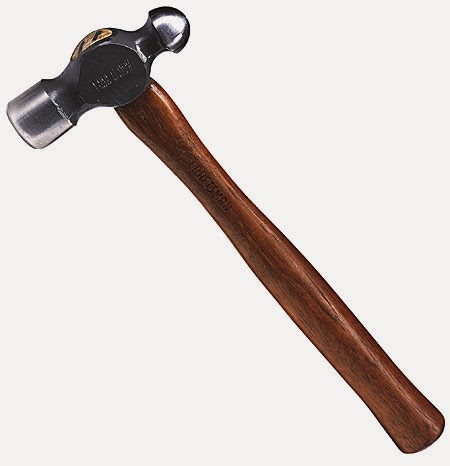
Hammering Home the Point

Photo: www.professionalequipment.com
Okay, before I go on I'm going to warn you that this is going to be yet another post about dog-equipment "discrimination". I personally don't advocate anything specific, or shun anything specific, so I have no real skin in the game here. So, why does it grate my cheese so thoroughly when people dis things like prong collars? Why can't I just let them have their point of view and get on with it? Well, simply put, I love dogs. I mean, they are the best people I know, and they deserve our love and respect. Does that sound incongruous to you? The fact that I love dogs and still have no problem with things like prong collars? Well, if you have any kind of foresight at all, it shouldn't. Quite plainly, by adhering to a singular training mindset and vilifying tools that, used CORRECTLY, have legitimately useful applications for some dogs and promoting your narrow viewpoint, calling all others cruel, you are KILLING DOGS. I have a real problem with that.

Don't believe me? Guess what, many experienced rescues (I don't mean folks who love dogs and have been doing rescue for a couple of years, I mean folks who have really seen it all) would agree with me. I have seen perfectly lovely dogs put down because some a**hole "trainer" couldn't expand their thinking enough to work with the dog in front of them. They were too interested in proving their own theory, and the dog simply didn't "fit". I have seen it over, and over again. My own personal (service!) dog would probably fit into that category for being nothing more than he is: A perfectly normal working-line dog. I really like the prong collar info that these folks put out: Bad Rap . I think the comments are pretty great too. Worth a read! Here's another one from Doberman Rescue Unlimited, a great rescue who 'gets it'.

It's such a divisive issue and it shouldn't be. Folks post pictures like this:
Photo: www.dogbreedstraining.com
Photo: www.k9kindness.org 

And then they use them to prove that these "devices" are cruel. Oftentimes injuries like the one seen on the poor pupper on the right are chalked up to "burns" from a "shock" collar. Guess what? That isn't even a possibility. Injuries like this are (in my experience) most often caused by folks who use underground fencing and never take the collars off the dog. The injury is caused by the incessant rubbing of the contact points on the dog's skin. INCORRECT use. For the record, I detest underground fencing on many levels, and am regularly flummoxed by the number of people who think "shock" collars are cruel but have no problem at all with underground fencing. What IS that? Incidentally, as soon as you say the words "shock" collar you are pretty much just highlighting how very little you know about they work. I hear someone say "shock" collar, and I know the rest of what they have to say is coming from emotion (and attempting to work on emotion), and has nothing to do with education, logic, understanding or experience.

The applications for prong collars are many and varied, and I believe well-covered in the links that I posted. Perhaps my favoritest-ever electric-collar use that I've seen was in working with a deaf dog. For her own safety, she had never been allowed off leash unless she was in her own fenced yard. Her world was consequently very small. Her trainer started working with her with the electric collar, using low-level stimulation as a reinforcer (replacing the clicker), and the vibration setting as a come command. Her first hike in the woods was a very emotional and joyful experience!

The anti-folks like to label and tell horror stories. They like to cite worst-case-scenarios and misuses as proof that certain tools are cruel. They post pictures and misrepresent the facts to prove their point. They say things like "A dog's neck is very sensitive" (It isn't, or they would tear each other up just playing...duh!). As long as we're posting pictures, here are some from "humane" training tools:
Photo: http://dogsintraining.wordpress.com/2011/03/29/not-so-gentle-leader/ 
And here's some good reading from the same blog: Dogs in Training

I understand that life "in the books" and in the bubble is a beautiful place. There is always support, dogs always want to do the "right" thing and there is always plenty of time and space to get things done the "right" way. But in the real world, outside the bubble, people don't have endless resources to surround themselves with training help. They have dogs that need exercise RIGHT NOW and don't have spaces of their own that they can control. In the real world, folks with tough dogs aren't getting support, they are getting blamed by "trainers" who aren't familiar (and don't want to be) with their dog's confident and determined mindset. The problems never get solved, the owner feels like a failure and back to the shelter the dog goes. That is the reality outside the bubble.

If you love dogs, then ask yourself: What's most important here? If you are a trainer, look at the dog in front of you. Look at the family. What does this dog and his/her family need to be successful? What will keep this dog's needs met, and keep him/her out of the shelter? If a family needs to be able to walk their dog down the street calmly and right now, and you are teaching them to "be successful" in the driveway because that's all your limited training theory will allow, you have failed.

Before you scrunch up your mind into a little tiny knot of very-specific training theory, remember that at the end of the day, dogs are individuals and they simply don't all respond the same way. They just don't. Have enough respect for their being-ness to understand that and take individual need into account. The happiness and success of the dog and it's family should be the real goal. Always.

Thursday, July 4, 2013

New and Old

Photo: www.naturalhorseworld.com
 First off, let me apologize for the lapse between the last post and this one. I went off on a related 'research tangent' that was productive and encouraging, and then I actually focused on getting some real work done. All in all, a productive time period. But here without further ado, my latest bit of wool-gathering:

I have spent my holiday perusing the internet for interesting horse info. It's hard to surf properly without running into lots and lots of info on "Natural Horsemanship", the barefoot 'movement', and riding bitless. I may date myself here a bit, but all of this info is new to me and some of it is making for some very interesting reading. I realize that none of this is terribly relevant to my life as it exists currently, but I am a horse person by nature and plan to have horses again as soon as finances permit. I poke around online to stay current and because it's really the only way to get a good horse-fix these days.

Okay, first of all let me make clear that, as a middle-aged woman who has ridden nearly since infancy, I am most familiar (and therefore most comfortable) with a more classical school of thought when it comes to horses. By classical, I mean the slow and steady bringing along of a horse though humane and methodical training, at the speed that makes sense to the individual horse. Of course, the definition and detail are much more complex than my simplified definition, but most people who ride and compete in 'English' sports know what I am talking about (whether they themselves are interested in adhering to classical principles or not). I won't say that I am an expert by any means and have found myself blessed by the help of friends who are much more capable than I, but the point is the same. In my view, correct training has always been humane training that takes the needs and nature of the horse into consideration. I have always been surrounded by people who felt the same. So what of "Natural horsemanship"?

I have never attempted it in practice. I know some folks who swear by it, and I know 'classical' trainers who are frustrated to no end by having to re-train horses who have been ruined by badly-done "Natural Horsemanship". I don't believe any system can be judged by the results of those who f*** it up though, but I guess that goes two ways. I have seen some pretty horrible riders trained in the classical method too (okay, admittedly most of them have been spoiled brats who's mommy and daddy bought them an expensive "toy" that they know nothing about, other than how to ride it around a ring and make it jump) but I know that, done correctly, it's a humane system that works. I think as long as it gets the job done kindly and the results are good, then why not? For some equine-enthusiasts, "Natural Horsemanship" IS the reason they ride. That's cool. I know folks who have a traditional background who incorporate NH to add something new and fun, and they do so with great results. I won't comment on western riding here because I am the first to admit that I know nothing about the western disciplines, but a lot of western folks seem to be really into NH. The one thing that does seem strange to me is that NH folks don't seem to do a ton of riding. I haven't seen a lot of NH folks participating in equestrian sports, at least not that I'm aware of. Is that a 'thing'? Again, I'm no expert.

Next on my confuzzlement list is riding bitless. Even from a traditional perspective, I totally get the appeal here. Less is more in the horse world (or more accurately, more training and skill means less need for gadgets), and it has always broken my heart to see a heavily bitted horse with his head tied down and his mouth gaping open. Even in the dressage ring, it is not uncommon to see an absolutely ridiculous amount of contact coupled with a tight noseband. In fact, both of those things make me NUTS and ruin my experience as a spectator. I would love to see riders in both the aforementioned camps lose their bit-privileges until they learn to ride with some compassion. I especially hate to see upper-level riders hammering on a double bridle. By the time you reach that level, you should know better. I rode saddleseat as a child. A CHILD. My horse wore a very potentially-severe double bridle, but instead of the crank-nosebands used by some of today's dressage riders, all we had were thin, decorative, pinned-ring cavessons. Even so, you never saw one of our horses with a blue tongue or a gaping mouth. I miss having the balance and finesse I used to have. I'll freely admit here that I am no longer a pretty rider. I am old and lumpy and waaaay out of shape. Just wanted to put that out there :-) Even so, I can work hard to be a good rider again when the opportunity presents itself, which is sort of the point. A bitless-bridle is something I could get behind. I spent some time checking out this site: The Bitless Bridle  Once I got past the very-strongly anti-bit stuff and the occasionally obnoxious marketing, I found that I really liked Dr. Cook and understood why riding bitless could be a good thing.

It certainly made sense to me that a horse would prefer not to have something in his mouth, especially if that something is attached to an unsympathetic pair of hands that treats it like an emergency brake or something to balance on. I tried to find folks who are sport-oriented who utilize bitless bridles, and there are a few of them. Perhaps my favorite is here: Uta Graf/Le Noir, bitless dressage Oh Uta, if only you were wearing a helmet! Oh well, She is still awesome. There seems to be a lot more folks out there using them on very old, or pet horses though. Lots of pics of helmetless people hugging ancient horses who are half asleep. There is merit here and I don't wish to discount anyone who has and loves their horse and wants to provide them with a positive experience. I just think that it would be nice if these bridles were more commonplace among sport-people (specifically the above-mentioned "brats"). It's certainly something I would consider, though they aren't allowed in dressage competition. Even so, I would imagine that much discomfort could be prevented in training if  a bitless bridle were used most often. Something to ponder...

Perhaps the most intriguing thing I've discovered is the idea of keeping a horse barefoot. I can't even begin to post links to all the info out there about barefoot hoofs and all the schools of thought around this type of horse management, but I will admit the scientific information is certainly compelling. If your experience is primarily with sport horses (with the exception of endurance) the idea might be crazy-foreign. But check out this perspective from world-class dressage-folks: Barefoot Dressage with Shannon Peters  This is something worth a try too, under the right conditions. I probably would always feel safer sending my daughter out on a cross-country course knowing there are studs in her horse's shoes, but for dressage? There are pretty terrific hoof-boots out there too. Again, not allowed in the dressage ring (the thing I love about dressage is also the thing I dislike about it: it's so darned fussy!) but one could always do what the Peters did, or opt to use a glue-on shoe for competition until the horse is reliably comfortable on all surfaces. I think I will always be the most comfortable with a farrier who also does barefoot trims as opposed to someone who is trained specifically as a trimmer because I have so much respect for the farrier-trade and faith in experience. I have noticed that many farriers here in Vermont actually do both. That is cool!

I would encourage horse people to maybe not just stick to the status quo. By all means, adhere to your principals, but at least consider exploring some of the new stuff that's out there that can actually function to enhance the old stuff you already know about. I'm am trying very hard to keep an open mind. If you know me, you know how tough that can be. I am also not entirely sold on the idea of  "natural" anything that involves us working with horses, as there is nothing natural about that from the horse's perspective, horses know we aren't horses, and I think we will do better by both the horses and ourselves by being confident and benevolent human leaders. BUT developing an understanding of the horse's nature and the physiological functions of all his parts is not a bad idea. No surprise there, but here's a newsflash: I am considering trying competitive trail in my next phase of horse-ownership. Is that crazy? I love dressage, SO much, but sometimes the idea of camping with my horse and riding through beautiful (and sometimes not beautiful) country just sounds so...liberating! What do you think?


Thursday, March 14, 2013

Mythunderstanding

I read an article the other day in which a dog trainer stated "I can't imagine any training situation in which I would employ a prong collar". I'm glad she said it that way. There was an addendum to the article that went on to ask "How hard a jerk on the collar is enough to have the desired effect of suppressing behavior without mentally or physically damaging the dog?" as though "jerking on the collar" is part and parcel of prong collar use and suppressing behavior is ever a desired goal. And even more disturbing to me "...if you punish in anger and your violence is reinforced, you are likely to get violent more, and more easily." HOLY CRAP. Do people really believe that this is what a prong collar is all about? And shouldn't a trainer have the education to know better? Having said that, if someone can't imagine a positive and practical use for this tool and has only been exposed to violence (!?) and misuse, then I agree: Don't include a prong collar in your box of training tools. You don't understand it well enough to use it humanely. But please, be self-aware enough to refer out any dog that doesn't fit within the limits of your training abilities.

It seems to be a very common thing these days: Using words like "cruel", "pain" and "never", and describing horrifyingly incorrect applications as "techniques for prong collar use" and then using this misinformation to perpetuate X, Y or Z training philosophy to the exclusion of all else. Look, if you don't like something, that's fine. If you think it's mean, to YOUR understanding, then that's your prerogative too. But if you are a teacher/trainer, then you have an obligation to educate yourself well enough to give factual information to your clients and NOT just perpetuate myths because they are convenient. Even if you have no interest in using a prong collar, you should at least make the effort to learn the truth about them instead of continuing to recycle the same misinformation. I like to tell horror stories as much as the next guy (okay, probably more than the next guy) but I don't try to pass them off as something they aren't.

So you train pets, and maybe do an AKC sport or two. The vast majority of dogs that you work with would never make it as a working dog because they don't have the temperament, and that's as it should be. Everybody's happy and you can go right on hating prong collars. But what do you do when a client has a tenacious, drivey working dog? You know what I mean, the confident kind that's powerful and strong and physically insensitive. How much do you think this dog gets walked, when, even after lots of training, there are still moments when this dog takes it's owner for a drag after a cat or squirrel? How happy do you think this dog is when he's permanently relegated (aka "managed") to doggie prison (the back yard), given to a shelter or killed because he's too much for his owner, all-positive training isn't cutting it and his owner is out of his or her depth? This is the side the issue that I've seen too often. Add to this the blame that gets aimed at the owner because their dog doesn't fit in "the box" and you probably are looking at a dog with a fairly limited life-span. As trainers, you have a responsibility to do better by the dogs in your care and the owners who come to you and pay you for your help. You have more responsibility for those lives than you do to adherence to a limited set of principles. Many of the best trainers I know don't like prong collars, but they can at least imagine a positive application and understand the need to be flexible when dealing with living and unique individuals.

Let me be clear here: This isn't my favorite tool. I agree that it's easy to abuse. What I object to is the perpetuation of misinformation by people who are in a position to know better and properly educate their students, and the perpeutuation of misinformation by people who don't have a clue simply because they lack the experience. As always I turn to Susan Clothier for common sense. She doesn't like prong collars either but understands (albeit reluctantly) they still have a place: Training With The Prong Collar 

Ms. Clothier doesn't just say "These are mean and you're a cruel S.O.B. if you use them". She has the wisdom and experience to share her opinion honestly but can add a real education based on an accurate understanding, not just incendiary and incorrect propaganda.

Sunday, September 23, 2012

All or Nothing

Some days I feel like an old person. I feel especially old when I see what I like to think of as "the inherent fervency of the young, inexperienced and uninitiated" playing out day in and day out. Yes, back to me ol' nemesis, Facebook.  It seems that so much is all or nothing these days as people stand up and shout over and over again, ad nauseaum "THIS IS WHO I AM AND THIS IS WHAT I STAND FOR" in several repetitious venues. I am including myself here;-) Hey, it's what social media is for, is it not? Most of the time I kinda love it. I love my friends and love to see what they're on about. For real:-)

I feel all kinds of observy, even when I'm participating. I have certainly made my political opinions known. But part of being observy in earnest is to point that fickle finger of judgement to oneself first. What, exactly, has driven me the most crazy about the political nonsense? Easy answer: first and foremost the mean-spirited, sarcastic (and let's face it) often ignorant and repetitive tone, and I mean that on both sides. I'm an old person who has never seen so much "dumb and ugly" all in one place, I mean to such an over-the-top ridiculous degree that it's mind-blowing. And it's from BOTH sides. While it's true that one side has definitely gone extracurricular with it, both sides are guilty and I have been too. And it's entirely pointless. What's being passed around isn't real or helpful information, it's entirely disrespectful and it's only function, it's ONLY function, is to create a rift. Is that something I want to be a part of? Am I crass, mean, reactive, sarcastic or any of the other unpleasant adjectives I could attach to this kind of behavior? I have my moments, certainly, but as a rule I am better than that. I know better than that. I was RAISED better than that by good people who were far above that behavior.  It's easy to get caught up in the steady stream of nasty, but it feels bad and well, it's beneath me. Politics shouldn't be all-or-nothing; we should be cooperating. Now THAT is something that's really worth getting behind.

My other pet peaves involve, well, pets. I guess I'm less "peeved" and more mildly annoyed, but there's an "all or nothing" trend in animal (for me that's horses and dogs) training as well. I am old enough to see fads come and go and to see real information stick. Unfortunately, trends usually have this huge swing from one extreme (in this case compulsion training for dogs) aaaaaalllll the way over to the other side (all positive, all the time) before common sense kicks in and levels things off a bit. I'm not new so I've already been to both extreme ends of this learning curve but there aren't that many of us yet. And it's a bit trying sometimes. It's hard to explain "Hey, I was you, but fifteen years ago". If it was a "to each his own" thing it would be fine, but some days I'm seriously NOT in the mood to get lectured by an inexperienced pet owner who took a class or two. Like today. Another lecture about my prong collar from someone who clearly knows just enough to be sanctimonious about training methods to total strangers. *Headesk*. Apparently if I use a prong, I don't know anything about positive reinforcement training. Well, except that I've been doing it for almost 20 years, I remember when it was new and have developed my training techniques as our understanding (through doing back then) improved. But hey, whatever. I offered to hand the leash over to her just as a (well-timed) squirrel passed by, but she didn't seem interested. They never do;-) Some people don't understand the concept of "management tool" and assume 'compulsion training' at the very sight of a prong and are too hard-headed to see any point of view other than their own. Oh, I know all about it. I've been that person. I know these folks just haven't met "that" dog yet. Hopefully if and when they do, they'll evolve instead of 'managing' the dog into isolation or giving it up as a lost cause. Based on my personal observation, it's about 50/50. I try to adopt a "smile politely and walk away" philosophy, which fortunately I was able to do today. Barely.

What about horses? Well, there has certainly been an uptick in the "Natural Horsemanship" trend. This, fortunately for you all, I have no direct knowledge about. I've always been a "humane, classical" kinda girl, but am not above giving something new a try. I think if a person is experienced (or is working with someone experienced) no harm is likely to be perpetrated here. In fact, I did a bit of digging around and saw quite a bit of merit to some of the methods. I do love the focus on groundwork and relationship-building (though admittedly there is plenty of both in classical training as well). The biggest potential flaw I see in these systems is that inexperienced or timid people might try to work with a horse with nothing but videos for guidance. THAT is a recipe for disaster, and I've heard of results to that effect. In all fairness, any method is only as good as it's application, and inexperience+horses without real, experienced guidance is a bad, bad formula no matter what method you choose. I know folks who are all about the NH to the exclusion of all else, and I don't think that's for me, but it certainly brings me to my point (finally!):

Moderation is a beautiful thing, and you can't make good choices if you are only well-educated in one side of the argument. Thinking you know isn't knowing, reading or hearing lots and lots of stuff from people who come only from your own point of view isn't knowing, and hearsay and misinformation certainly aren't educational or helpful. If you want to stand firmly by your opinion fine, but at least take the time to learn about the REALITY of other points of view. Phew...I feel better:-)

Next time I review my favorite dog coat company, just in time for cold weather:-) Cozy Horse

Friday, August 10, 2012

Warm and fuzzy


Photo: Huffington Po
I've had a bit of a tough week, but consoled myself with a 'time out' and some Olympic dressage. It's the first time in a long time that I can recall watching equestrian events on television, and I haven't seen any dressage in what feels like forever. This year the stars aligned so that the Olympics occurred at a time in my life when I actually have cable. Cool beans.

As thrilling as it was to have the opportunity to watch, I will admit that I was somewhat disheartened by what constitutes Olympic-level dressage these days. I saw more than a few horses working front to back, overbent and tense, with mouths gaping open. I have no doubt in my mind that this is a direct result of Rollkur used in training. Not only was it used in training, but in the warm-up area at the Olympic games, and even on the way to the arena. It is supposed to be an illegal technique, but nothing was done about it by stewards or officials. Shame. I thought I was alone in my disappointment until I read some of the many comments on the FEI Facebook Page . Holy kaka batman, but people are cheesed off! I encourage you to follow the 'Rollkur' link if you are interested in understanding how abusive and ugly it is. It seems like it must be a new-ish thing, as I don't recall it ever being a part of classical training. Of course, I AM old though;-)

I love dressage, or at least what it is supposed to be. When I was first learning about it many years ago, I read a book (two, actually, as I wore out the first one) by Alois Podhajski called The Complete Training of Horse and Rider. I believe it was published in the late 70's, early 80's, and it was a fascinating read for anyone interested, even peripherally, in training a horse. Colonel Podhajski was a pretty amazing dude. He was the director of the Spanish Riding School in Vienna, Austria during WWII and is even credited with saving the Lipizzaners (with the help of General Patton). Here is his wiki page: Alois Podhajski
Even for non-equestrians, the story of Colonel Podhajski and his Lipizzan stallions is an interesting bit of history. He is a man I've never met, but my familiarity with his writing has given me a great deal of respect for this amazing man. His sensitivity to the horse and his compassion jump off every page even as he's describing training techniques in great technical detail. My point is, this man was my first introduction to dressage and he set the bar on most of my experiences and opinions since. One can only wonder what he would think of today's competitive dressage.

So often, "new" is synonymous with "better". This is one of those circumstances when "old" and "traditional" definitely should be the standard.  Dressage is one of those sports that has declined and fragmented as tradition has been left by the wayside. People are replacing common sense, time and sensitivity with rope halters and games. Don't get me wrong, "natural" horsemanship has it's merit, especially in light of what passes for training so often these days, but it seems to be a response to a need to be more kind in the training of horses. If the principles of classical training were still adhered to not only would abusive training like rollkur disappear, but there would be no need to seek more compassionate training methods. I'm just sayin'.  I won't bore you with the details here, but suffice it to say I spend a lot of time watching and shaking my head. To each his own I suppose. I will say that since I was a kid (back when dinosaurs roamed the Earth) that some things HAVE improved. I love some of the new bits. As we've learned and understood more, we've developed more anatomically-friendly bits that can enhance classical methods; bits by Herm. Sprenger and Neue Schule especially come to mind. And I would be lying if I said my old, lumpy self wasn't excited about the development of flexible stirrups like these: system 4 stirrups. Much easier on the ol' bones, especially the knees. But I digress.

As disheartened as I felt about most of what I was watching, one great story did unfold. The gold-medal winner was a young British woman named Charlotte Dujardin, riding her wonderful horse, Valegro (pictured above). Valegro was supposed to go to Charlotte's coach, Carl Hester (also a British team mate) but he loved the pair of them together, so history was made. Not only is this a great story because this wonderful coach let go of his ego and gave a student the opportunity to shine, but she shone without the use of cruel training practices and she WON. Not only did she win, but she did so wearing a safety helmet. At the upper-levels of dressage it is traditional to wear a top hat. Many dressage riders won't even wear a helmet when they train. I am a HUGE advocate of the safety helmet, and am so pleased that this wonderful young rider set such a great example to other up-and-comers by making safety a priority and doing it with style. The story of Charlotte and Valegro was where I garnered most of my "warm fuzzies" this week, and knowing that conscientious folks still exist gives me hope.

Friday, June 8, 2012

National Helmet Day

A nice GPA riding helmet
 Hey! It's national helmet day! Even though I am in between horses at the moment, I can still be on board with riding with a helmet. Wearing a helmet is such an easy thing to do and makes such a big difference in terms of safety, I can't imagine why anybody wouldn't. It wasn't always that way.

When I was a kid, it was the norm to ride bareback. Jeans, sneakers and t-shirts were the 'correct' attire (unless it was hot, and then bare feet and shorts were the order of the day), and nobody wore helmets. Yes, we were injured a lot, but fortunately we managed to avoid serious injury. We were lucky. My sister and I owned a helmet (one between the two of us, if that's any indication of relevance) but it was strictly for looks. It was pretty and velvet, but offered no real protection in the event of a fall. When we competed, we were in soft derby hats, had flat, cutback saddles and solid fillis stirrups. My how things have changed! Fortunately, people know better now.

Now, it is a requirement that all riders under the age of 18 wear ASTM approved/SEI certified helmets when competing in all disciplines. The United States Pony Club takes it even further; they recommend safety stirrups as well. As a parent, I can't tell you what a relief it was to know that those rules and guidelines were in place when my daughter was involved. To send her out on a horse with a bare head would terrify me, as would the thought of her hanging up on a stirrup. Equestrian sports are dangerous enough, it helps SO MUCH to stack the survival odds in your favor by using the correct safety equipment.

There are some folks that still can't be bothered though, and IMHO they set a bad example while risking their own well being. There are some breed shows that are more concerned with a 'low profile' appearance than safety. Many folks in the dressage world are "too cool" to school in a helmet. I have seen more than a few natural horsemanship enthusiasts riding helmetless as well, though I think many of them fall into the 'western' camp. I have rarely seen a western rider wearing a helmet, though I'm not really sure why? Perhaps it's the preference for cowboy hats? The western folks that I asked seemed to feel that helmets were more of an English riding accessory, and that English riding was more inherently dangerous, anyway. Maybe that's true, but there are lots of great helmets on the market in many styles including those with a very western appearance.

There are so many helmets on the market today, that there is something for everyone. There are lightweight, ventilated helmets for endurance and trail, cute colorful helmets for children, very traditional helmets for a conservative and traditional hunter look, and really cool, sporty ones for the eventers and show jumpers (like the neat GPA pictured above). It can be hard to choose just one (I think between my daughter and I we have 5?). They range in price from about $30, all the way up to $500 or more. The only thing they have in common is that they are all designed specifically for equestrian use. And THAT is important. I have seen people put bicycle helmets on their children for horseback riding, and that's a very dangerous thing to do. Bicycle helmets protect different areas of the head, and are not at all suited to equestrian use.

Technically, as an old lady and fairly experienced (though rusty at this point) rider, I am not required to wear a helmet. But I do. Every time, every ride, even on an elderly Percheron.  I am very aware of the risks involved with riding an unpredictable, 1000 pound prey animal. I know how quickly things can go bad and how bad they can go. It's so easy to get hurt, and with the advent of good safety helmets, the head injuries of my day can be just a thing of the past. I think I'm much 'cooler' with my brains intact, even if it means sporting a helmet that doesn't necessarily highlight my features. I'm very pleased with how normal it has become to ride with a helmet, and very pleased that kids growing up these days are in the habit of it. Even though I grew up without them, as an adult I will always ride with a helmet.

Wednesday, May 2, 2012

Product Review: Bold Lead Designs Pt. 2

Murphy sports his new harness
   First, let me apologize for the length of time between parts 1&2. My poor daughter has mono, and has been sick for a couple of weeks already. Perhaps that shouldn't distract me quite as much as it has considering she is almost 20, but there's something a little 'overly' about the single parent/only child relationship that I can't quite explain. Anyhoo, now that we know what's wrong I can get on with it:-)

   As much as I believe in words and the power of hyperbole, I can't say enough good about this harness. My first impression when I opened the box was "WOW!". As many of you know, I was a horse person long before I was a dog person. I was a dressage enthusiast (with an eventer daughter) so I have seen and handled my share of high-end horse equipment. When I lifted my new harness from the box I was transported back to a time when I had just received a new piece of expensive tack. The smell of leather was delicious and the quality of the harness was evident from the first glance.

  The leather is smooth and soft with all of the edges beautifully finished. The stitching is tight, neat and even. All of the hardware is shiny and strong and clearly of good quality. It is lined with real sheepskin in all of the appropriate places. There is so much to it, it looks like it should have some weight to it, but it's really quite light-weight. If all I was going to do was look at this harness, it is a thing of beauty. But of course that's not it's purpose, is it?

   As beautiful as it looks, the real beauty is in it's use. Everything is well thought out, the handles are in exactly the right places and it fits my dog perfectly. I have one of those opinionated dogs who is quite particular about his equipment. If something doesn't feel right, he just stands in the center of the room staring at the floor, or running around trying to dislodge whatever it is that irritates him. I have always welcomed his opinion even when it was inconvenient because it is his body, after all. When Murphy first saw the harness, he gave it a tentative sniff and then looked at me like "that's for me, isn't it?". I gave him a treat, put the new harness on and adjusted it, and he was cool with it right away. It was one of those really rare times when there was no adjustment period needed, so clearly the harness is comfortable. Murphy sits, lays down, moves freely, etc. as well as he does when he's naked.

  This harness is exceptionally well-designed. Murphy's initial reaction clearly speaks to it's comfort. There are quick-release buckles (on the correct side of the dog if you work your dog on the traditional left side...awesome!) which makes on/off super easy and quick. The chest piece is high enough not to interfere with the dogs forelegs, and the whole thing is very stable. I have found that just grabbing the sturdy handle in those moments of need kind of short-circuits the vertigo. The pull handle has already gotten me out of a jam or 2, too. I have not fallen at all since receiving the harness, and only had one close call that was staved off by my bracing dog and the sturdy leather handle. Yes, this harness is 'all that', and more:-)

   In addition to the harness I also bought a working dog leash, a harness pack and a couple of patches. Of course all were of impressive quality as well. The leash is beautifully made of leather that matches my harness nicely, it's a perfect weight and has rings in exactly the right places. The patches are two-sided and Velcro back-to-back and fit quite nicely on the harness straps. the graphics are vivid, neat and detailed. The harness pouch is a Sherpani 'Zoe' wallet modified slightly to attach to the harness. It's the perfect size and exactly what I hoped it would be. Katrina suggested I get the pouch in red to match the red accents on the patches and it was a good call:-) The combo looks quite striking on my black dog.

   In my box of goodies there was also a key ring, and clip-on service dog button and most importantly, an envelope with an owner's manual outlining correct adjustment and fit, cleaning how-to's, and helpful tips about introducing the dog to the harness and harness use. Once again, I am as impressed by the support as I am by the beautiful harness. I have no trouble at all recommending Katrina and her company Bold Lead Designs. If you want great service, high-quality equipment that does exactly what it's supposed to and ongoing and friendly support, there's nobody better:-)

Friday, February 10, 2012

Bone of Contention

   I have an obscene amount of dog-related reference material. Not only have I read/watched it all at least twice, but I mentally sucked the info off the pages/off the screen with an obsessive voracity to rival any, well, obsessively voracious thing. While I'm super psyched that we've learned so much since the "Kholer" method, I've noticed things going WAY over in the other direction. Not only have I noticed it in print, but on the streets of my town and in dog-culture in general. Nobody believes in consequences any more, and it's not a good thing. I suspect there would be far fewer dogs in shelters and less euthanization if more trainers were willing to take a more balanced approach. All positive all the time doesn't work for all dogs. It doesn't mean the dogs are hopeless cases, not by a long-shot; but it does mean they need something more than an absence of a reward to make an impression.

   Before I go too far down this road, I want to make damn sure that I'm clear about something: I believe in TRAINING. With both my horses and my dogs, nothing has improved my relationships with my animals more, or brought me nearly as much satisfaction as watching them enjoy something that I was teaching them, and both of us learning something about the other in the process. My most clear memories, of course, are with Murphy. He's so incredibly beyond intelligent that it blows my mind sometimes. When I began to open the communication channels during puppyhood via clicker-training, I was astounded by how fast he progressed. If you've ever had the pleasure of shaping an intelligent dog you know how incredible the feeling is when you get to see how their mind works. I can't imagine doing things any other way. BUT....

   There is a big 'but' there for a reason (and it's not the one on the back of my front); what about the other side of a dog's education? I've read, so many times, that consequences are mean and horrible. Huh? Are any of these folks parents? Or have any of them had the "pleasure" of being around a child who's never had to deal with a consequence? I think (or hope) it is common knowledge that part of a child's induction into the world of adulthood is a solid upbringing primarily focused on unconditional love and positive reinforcement, but also includes consistent discipline and consequences for undesirable behaviors. Anyone disagree? And by 'consequences' I don't mean spanking. I'm not a spanker. But I DO mean whatever consequence is appropriate and meaningful to the specific child. So why can't dogs experience consequences? I guess I don't get it. I know there are trainers who feel that lack of a reward or a 'time-out' is appropriate for a dog, but dogs aren't children and they don't reason the way children do. My dog wouldn't consider a lack of a reward for a self-rewarding negative behavior (like squirrel chasing) any consequence at all, and as smart as he is a 'time out' would be meaningless to him. So, huh?

   I know the arguments: "Whales and dolphins are trained with positive-only training. You can't correct them so you have no choice". Yeah, I can see that. On the other hand, I've never had to walk a whale or a dolphin down a city street, or through security at the Orlando airport prior to subjecting them to the full TSA-treatment before boarding a plane where they are expected to lay quietly for the flight (whew...that sentence was long!). I also never had to share my home with a whale or dolphin, or get one to ride quietly in an elevator with children, wheelchairs, walkers, etc. Anyway, you get the point.

   The other argument that I've heard (and this one speaks to me more about inexperience than anything else) "If the dog knows what you want, they will do it." I don't know about you, but my dogs have all had their own opinions about things. Where are they finding all these compliant dogs? Don't get me wrong, I've known a few that really were saints, but they have been few and far between. I will concede that a dog that you have a good relationship with will want to work with you and want to learn from you. They will also respect you (this is two ways, in my opinion) but not fear you (if you have to bully your dog into minding you it's because you don't have their respect.). I also believe in clarity and minimizing my impact on the physicality of a dog. So, what the hell does that mean?

   It means that I prefer to use whatever has the least amount of negative effect (or force) on a dog's body. I'm going to pick on Victoria Stillwell for a minute, but I don't really mean to. I actually love the way she advocates for dogs and calls the owners on their (often lazy) s***, but I disagree with some of the things she says and I'll tell you why: On one show (Greatest American Dog maybe?) she gives a contestant crap for using a 'snarl band' and proclaims "I don't like anything that effects the physicality of a dog" (not verbatim), but then on HER show she puts one of those 'no pull' harnesses on a dog. The kind with the cords that dig into the dog's pits. I don't care if the cords are covered with fleece, they are still digging the dog's pits. She also like to say "The neck is a very sensitive area on a dog." Um, no, it's not. Dogs do things to each others necks just while playing that would send you or me to the emergency room in a heartbeat, but they don't seem too flummoxed about it. What IS sensitive though, is a dog's pits and certainly their faces. But that doesn't stop people from self-righteously tossing out their 'cruel' prong collar in favor of a pit-digging harness or a headcollar. To me, a headcollar is the very definition of 'interfering with a dog's physicality'. While it's true that these devices offer consequences of a sort, are the consequences anything that makes sense to the recipient? Well, they certainly appear to be uncomfortable, but in a constant way and not in a way that communicates anything meaningful.

   Isn't it better to teach the dog, very clearly and in an unmistakable and fun way, but let them know that misbehavior has a consequence? Example: Murphy knows how to walk on a leash. walking doesn't stress him or his body because he was taught what was expected of him in a clear, enjoyable manner. He also loves to go after squirrels. If he does, he will hit the end of his leash and be reminded (via his prong collar) in exactly the most appropriate instant, that it's not allowed. Crisis averted. While it's 100% true that the more training you do the less force you need, if you think you are going to train an 'incompatible behavior' to squirrel chasing and it's going to be enough, all on it's own, to stop it? Well, good luck with that. I have no doubt that some dogs would respond favorably, mine won't. If you want to try it with my dog and prove me wrong, I invite you to go for it;-) To me though, from a strictly structural perspective, isn't this the least forceful manner to walk the dog? I see people getting dragged down the sidewalk with dogs in harnesses all the time because they don't want to hurt the dogs body, but can you  imagine the amount of force on a dog in this situation?

   I don't understand how otherwise perfectly rational, reasonable folks who raise lovely, well-behaved children suddenly go over the edge at the very thought of their dog experiencing a real consequence (one that makes sense to the DOG). It certainly explains a lot of what I see every day though. Unfortunately, while an undisciplined child may spend time in prison, it may mean a death sentence for a dog. Unruly behavior certainly doesn't make dog-people more popular in the world either, or make the world a more accepting place. Balance is AWESOME.

Friday, February 3, 2012

Perspective

Murphy in his cool shades
   "The older I get, the less I know" That's what my mother always says, anyway. When I was a teenager I thought she meant that she was getting feeble in her 'old age' (she was the age I am now) and was losing brain cells, or that she was so old her memory was slipping. Nope; she's still sharp as a tack. I do get it now though.

   When I was in my twenty's I thought I knew everything. On the rare occasion that I would concede to NOT knowing everything, I would still insist that I knew most of what I was talking about. By the time I reached my thirty's I understood that only a little information could be a dangerous thing indeed. Now that I'm in my forty's I'm much more receptive to the idea that sometimes, there are things that I know nothing about that are worth further investigation. Sometimes there are things that I know well that STILL are worthy of an informational update. Some folks don't need to get this old before their open-minded-ness allows them to have a solid, well-rounded perspective, but I'm kind of stubborn so I did. It's still a work in progress. My biggest incentive has been my interest in providing the best care for my animals (even if I only have one 'animal' right now).

   There is a huge push forward in the world of holistic animal care. It's really very cool, even if I resisted it a bit at first. The irony here is that the more things progress, the more we go back to basics. I remember reading about raw diets for dogs and all the grumbling I did about it. "I don't need to do that, I feed a great dog food, what about salmonella, I don't want the mess....blah blah blah...." But I was surrounded by people who fed raw; successful, professional people who's dogs looked great and never (or rarely) ever got sick. Often their vibrant health led to an extended life-span that long-time raw-feeders almost seemed to take for granted. I had just lost a 10 year-old dog to cancer so I felt some motivation to at least look into it. I read some more. I didn't just read about the arguments 'for',  but also the arguments 'against'. No matter what your point of view on almost anything, you are likely to find information that supports it. (Google anything you want, I dare you). I think it makes much more sense to look at ALL the valid info out there and then make your decision (about anything) and consider the source. It took two years of research and thought, and then I switched to raw. I've never been sorry. The downside is that I will never be able to feed dog food again (unless there is a pressing health concern that disallows raw) without feeling guilty. But it was REALLY HARD for me to change, and to open my mind to the possibility that I might be wrong, or might not be doing something as well as I could be. It requires an open mind and a degree of flexibility; something I still struggle with (really hard sometimes) but becomes more accessible with age and experience.

   But this isn't about raw feeding, it's about perspective. When do you know you have it and how do you handle people who don't? Within my tiny little bubble of knowledge, it would seem perspective comes with experience.  Take my views on prong-collar use for example: I don't just advocate use of them arbitrarily on principal. I used them years ago because that's what there was. Then I disliked them because they were 'mean', then I REALLY learned how to train, and train a wide variety of different dogs with varying needs, including working dogs, and I learned proper and conscientious use of the prong-collar so I liked them again. It took years and a wide variety of experiences to give me enough perspective to come full-circle and be open-minded on the subject. So how do you deal with it when Joe-blow with an unruly, out-of-control lab mix (or someone with similar and obviously inadequate dog-handling skills) tries to lecture you on your choices? Or someone who is 'certified', but has never trained anything but soft pets (or has no problem with 'managing' a dog into social isolation) tries to tell you your choices are cruel? Isn't relegating a dog to a life of management a cruel thing to do, especially when having an open mind would mean better options? And isn't it cruel to use a piece of equipment that drives the dog nuts? It seems rude to be as dismissive as I feel, but really? And on the flipside, If you see something you disagree with, when is it okay to step in? I recently saw someone correcting the hell out of their reactive dog, and it took everything I had not to grab the leash out of their hands. Who am I to say my way is better (even if I suspect their dog would agree)?

   I will admit to being FAR MORE concerned about the needs and opinions of the dogs in our care than in the needs of the humans involved. Maybe that makes me a horrible person, but I know more than a few that feel similarly and I like them just fine. But I get tired of both the Disney-esque anthropomorphism ( I let him do it because he wanted to) AND the brutish "Show 'em who's boss" mentality. Dogs don't want to be people and they don't need to be bullied. I don't think it requires a great deal of experience or perspective to come to that conclusion, just a bit of common sense. But you know what they say about that.

   The older I get the less I know. While that is true, the few things that I do know something about (because I've taken the time to learn, heard all of the arguments and put things into practice for myself), I REALLY know. Even so, I continue to work exceptionally hard (because for me it's exceptionally hard) at keeping an open mind and hearing the opinions of other people. Maybe I'll continue to get better at it with age.

Sunday, January 15, 2012

What Does the Dog Think?

    There are definitely times when I REALLY don't want to know what my dog thinks. I especially don't appreciate the looks I get when I'm getting out of the shower, or waking up to find that I fell asleep sitting up on the couch and I'm drooling. I usually open my eyes to find my dog staring at me like I'm some fascinating but horrible museum exhibit that he just can't tear his gaze away from. It's a bit disconcerting. Murphy is quite expressive, and he's not one bit shy about expressing his disdain or disapproval. And I can't be absolutely sure, but I could almost swear that he laughs when I fall on my keester when it's icy.

   I've found over the years that in spite of the language barrier, dogs are exceptionally good at expressing themselves if you are at all willing to listen. My first dog, a Greyhound named Garth Smart, could express a myriad of emotions just with his eyes. His favorite expression of all was the 'martyred sigh', which he had honed to perfection.

   Murphy isn't given to such things as subtlety, and prefers instead to emote forcefully and oafishly through his life. There is no mistaking Murphy's opinions. I rarely have to wonder what he is thinking, and he's quite annoyingly-direct about his likes and dislikes. On some level I have been grateful for this tendency because Murphy is a service dog and it has helped the two of us to develop an understanding and cooperative working relationship. I've found some of his opinions to be both entertaining and enlightening, particularly his opinion of headcollars (both Halti and Gentle Leader).

   I decided to try a headcollar after Murphy was attacked (full story here) and became reactive. I had trained Murphy first with a flat leather collar, and then moved into a prong collar after he learned manners and knew how to give to pressure and walk politely (see how that works? TRAIN them first, THEN use the stronger tools when you add distractions...just sayin'...). For him the prong elicited no more of an emotional reaction than the flat collar; it just 'turned the volume up' when we started working in more complex situations. It's like training a dressage horse: you work for years in a simple snaffle, and only use a double bridle on a fully-trained horse to refine the communication. Such is the nature of my prong-collar use. Even so, I was reading all manner of stuff on the subject. I trained Murphy with lure-reward and clicker methods, and many of the positive folks advocate head collars. "Sure, why not?" I thought to myself. It can't hurt, right? Well.....

    So I did a month-long deal, teaching Murphy to accept the thing on his face. It took another month to get him to accept the pressure of a leash without completely freaking out (read: throwing himself to the floor in a dramatic fashion and pawing at his face). It occurs to me now (but didn't then) that if something takes that long just to be ACCEPTED, if it's that tough to deal with out of the gate, it may just not be a great idea. Nope; didn't occur to me then. We had to walk around with it for awhile, Murphy throwing regular tantrums (and breaking his first headcollar. Dummy-me went and got another one) and basically hating walks. Needless to say, it didn't help anything. I thought that by sparing any possible negative stimulation from the prong-collar, Murphy's rehab would be simpler and progress faster. Instead I turned my cooperative and happy dog into a dog that dreaded work, dreaded walks and pawed at his face any chance he got.

   Fortunately, I had an epiphany. One morning I got out the headcollar for the morning walk and found my 100 pound dog trying to squeeze himself into the 8" or so space beneath my bed. Murphy had spoken, and I finally listened. The headcollar was made of soft straps; the prong collar looked scary and mean. Murphy wasn't fooled by appearances. The headcollar wasn't humane or kind, it was an aversive that he couldn't escape. A prong collar only activates when the pressure is needed. It made perfect sense to Murphy. Just wearing the headcollar was aversive. No matter how well-behaved he was, Murphy couldn't escape the annoying thing on his face. In his very direct and dramatic way, Murphy taught me something vital: If you want to know what the humane choice is, don't base the choice on your own emotional reactions; ASK THE DOG. How can you work cooperatively and with focus if your tools, by their very existence, create resistance and distraction?

   A month or two after we had given up the headcollar experiment, we were walking along the sidewalk and encountered a woman walking toward us. She stopped to tell me that she was a pet-owner who had taken a class (oh boy! LOVE advice from random pet owners...) and she thought that my prong collar was mean. She suggested that I try a headcollar (I was glad that I was all incognito that day with my super-dark, Lennon-esque shades because I'm pretty sure I involuntarily rolled my eyes). I told her that we had, and that we had had terrible experiences. She shook her head knowingly and patiently, and told me that I really should have stuck with it. After an awkward conversation in which she suggested that "the more a dog resists, the more they need the magic of the headcollar" and I just kept saying "no", I asked her where her dog was. I learned that her Golden Retriever (oh really? you mean NOT a high-drive Doberman?...huh...) was at home. Apparently, she just can't handle him on walks so she doesn't walk him any more. Seriously?